
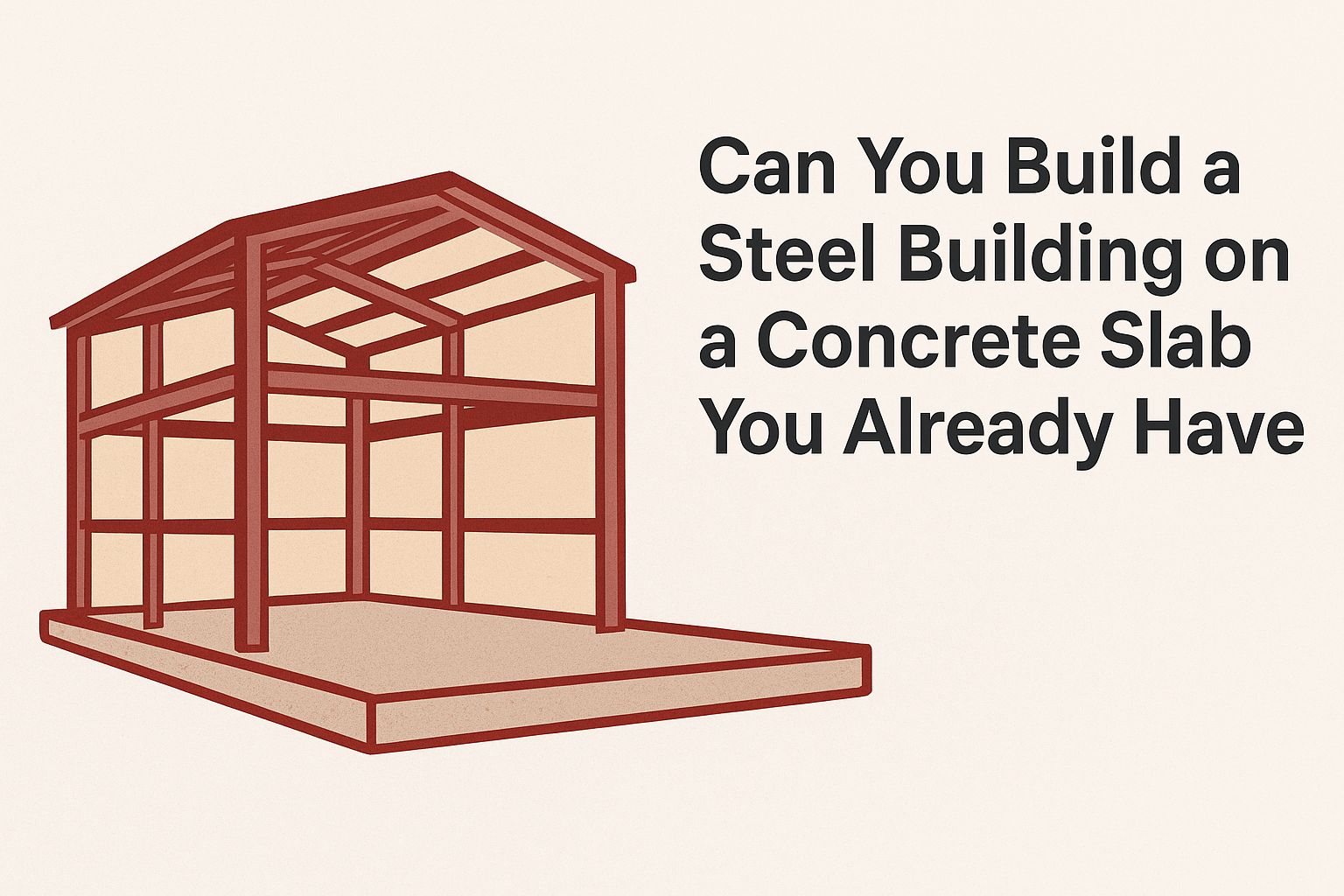
Can You Build a Steel Building on a Concrete Slab You Already Have?
Staring at that weathered concrete slab in your backyard, you’ve got visions of a sleek metal or steel building rising up as a shipping container alternative-fast, strong, and affordable. But can your existing foundation handle the load without crumbling when you build on slab? This matters if you’re eyeing cost savings on new foundations. Dive in as we inspect your slab’s condition, match it to steel standards, tackle fixes like reinforcement and anchoring, and weigh the upsides against pitfalls to see if it’s a go for construction feasibility.
Overview of Steel Buildings and Concrete Slabs
Steel buildings, often metal buildings or pre-engineered buildings, are prefabricated or modular construction structures using galvanized steel frames with corrosion protection via galvanization and painting, columns, girts, and purlins, while concrete slabs serve as the flat, load-distributing base typically poured 4-8 inches thick with 3,000-4,000 PSI strength, meeting key foundation requirements.
To build one, start with primary steel components like I-beam columns (e.g., W8x10 sections) anchored to the slab using 1-inch diameter anchor bolts embedded 12 inches deep. Secondary elements include Z-shaped girts and C-shaped purlins using bolting or welding at 5-foot intervals for wall panels and roofing system support, including doors and windows.
For slab preparation, begin with site preparation involving excavation, backfill, and a gravel base, then place a rebar grid (#4 bars at 18-inch centers both ways) on top of a 6-mil polyethylene vapor barrier for radon mitigation, apply termite treatment, and install expansion joints every 20 feet. Use a 3,000 PSI concrete mix, allowing sufficient curing time.
Per ACI 318 standards from the American Concrete Institute, a 1,200 sq ft garage or storage building requires at least 5-inch concrete thickness for vehicular loads.
Unlike wood framing or a pole barn, steel offers superior fire resistance (up to 2 hours), pest resistance, and termite immunity, reducing long-term maintenance, while providing energy efficiency, sustainability through the use of recycled materials, and other steel advantages like longevity, with options for customization and potential for green building and LEED certification ( the pros and cons of steel buildings in 2023).
Feasibility of Using an Existing Slab
Assess feasibility by hiring a structural engineer for a $500-1,000 inspection to confirm your slab’s 2,500 PSF load capacity matches your 30×40 steel building’s 1,000 PSF snow load requirements.
Once inspected, review your slab’s original pour specs from municipal records or the builder to verify concrete strength (aim for 3,000 PSI minimum). Next, have a geotechnical firm do a soil test ($300-600) to assess soil conditions so the soil compacts to 95% Proctor density and avoids settlement problems, considering the frost line.
Use ASCE 7-16 standards to calculate additional loads, factoring in wind and seismic per your location-tools like SkyCiv software simplify this.
This retrofit can save $5,000-10,000 over a new pour, providing significant cost savings, especially with DIY construction or professional installation for kit buildings from a supplier or manufacturer, often including warranty, assembly instructions, tools needed, and estimated time frame, but watch for red flags: slabs over 20 years old fail 40% of retrofits, per FEMA P-1542 studies.
If viable, proceed with anchoring bolts rated for your loads.
Assessing the Existing Concrete Slab

Before anchoring your steel building, check the slab to make sure it is at least 4 inches thick and has no cracks wider than 1/4 inch.
Visual and Structural Inspection
- Begin with a visual scan using a flashlight and magnifying glass to spot surface defects, then call in a structural engineer with tools like a Schmidt hammer to test concrete compressive strength at 3,000 PSI minimum.
- Next, perform a tap test: Walk the slab, tapping with a metal rod or chain to detect hollow sounds signaling delamination-aim for uniform solid echoes. Document findings using apps like Concrete Inspector for timestamped photos.
- For deeper analysis, hire the engineer for core sampling: Extract 2-3 cores (4-inch diameter, $200 each) to lab-test for voids or rebar corrosion.
- A 2018 Portland Cement Association study revealed 25% of slabs over 15 years old have hidden defects.
- Compile reports for permit compliance or repair bids, ensuring all data supports insurance claims if needed.
Checking for Cracks and Damage
Examine cracks for crack repair using a 1/16-inch feeler gauge and perform moisture testing; hairline cracks under 1/8 inch are often fixable with epoxy injection kits like Simpson Strong-Tie, but structural ones over 1/4 inch require professional evaluation.
To categorize, measure each crack’s width and depth: vertical or horizontal shrinkage cracks (under 1/8 inch) result from concrete drying, while diagonal ones often indicate settlement from soil shifts, as noted in the US Army Corps of Engineers Concrete Manual.
- For non-structural fixes, start by sealing with Sikaflex polyurethane sealant ($8-12 per tube) to prevent moisture ingress.
- Next, inject low-viscosity epoxy ($10-15 per linear foot) using a dual-cartridge gun for hairline repairs.
- Monitor progress with tell-tale gauges ($5 each) over 3-6 months.
A Florida home retrofit, per ASCE case studies, saved $8,000 by repairing 20 feet of cracks this way, avoiding full demolition.
Measuring Dimensions and Flatness
To check dimensions and flatness, use a straightedge or laser level to measure the slab’s dimensions and confirm the flatness fits the building’s footprint. Any deviations may require leveling slab before proceeding with construction.
Also, consider overhang from the building design and integrate a gutter system for effective drainage management.

Slab Requirements for Steel Building Foundations
Your existing foundation or existing slab must meet foundation requirements and ACI 318 standards with at least 4 inches concrete thickness, #4 rebar at 12-inch centers, and 3,500 PSI concrete to support a steel building’s 500-1,000 PSF live loads, suitable for storage building, garage, workshop, commercial building, or agricultural building. To determine the appropriate size that aligns with these load requirements, follow the methodology in our guide to selecting the perfect steel building size.
Minimum Thickness and Reinforcement Standards
Aim for 5-6 inches minimum thickness reinforced with 6×6 W1.4/W1.4 welded wire mesh or #4 rebar grids, achieving 4,000 PSI compressive strength per ACI 318-19 Section 7.7.
Adjust thickness based on span: use 4 inches for 20-foot bays in light-duty areas like patios, scaling to 6 inches for 40-foot warehouse spans to prevent cracking under loads up to 3,000 PSF.
The minimum reinforcement ratio is 0.0018 according to ACI 318. This provides tensile strength.
For residential garage slabs, add polypropylene fiber additives at 1.5 pounds per cubic yard. This controls cracks, as stated in ASTM C1116 standards.
Test compressive strength via 28-day cylinder tests (ASTM C39), targeting 4,000 PSI for durability.
Reference IBC Table 1809.7 for footing integrations and utilities integration, where slabs over expansive soils require 12-inch depths, accommodating electrical conduit, plumbing, and HVAC systems.
Load-Bearing Capacity Evaluation
Evaluate load bearing capacity using finite element analysis software like ETABS to confirm 2,500 PSF dead/live load support, factoring in 20 PSF snow load, 90 mph wind load, and seismic considerations per ASCE 7-16.
Begin by gathering loads: dead load at 150 PSF for steel frames and live load at 100 PSF for occupancy. Apply load combinations from ASCE 7-16, such as 1.2D + 1.0L + 0.5S for strength design.
Do a plate load test ($500-$1,000) to measure the soil’s bearing capacity. Consult a structural engineer for the modulus of subgrade reaction, typically 300-500 pci.
For example, a Colorado workshop or commercial building upgraded for 50 PSF snow load by adding $3,000 in piers, ensuring compliance and preventing settlement per ACI 318 guidelines.
Compliance with Building Codes
Get building permits from your local building department to follow the rules, including zoning laws. Use IBC 2021 Chapter 19 for concrete and AISC 360 for steel. Have inspections at 25%, 50%, and 100% completion for certification.
To make the process easier, follow this compliance checklist:
- Submit detailed plans stamped by a licensed Professional Engineer (PE), typically costing $1,000 or more depending on project scope.
- Check that the seismic design category (SDC) is C or higher for seismic considerations, and add wind load requirements from ASCE 7-22, while ensuring accessibility, ADA compliance, and safety features like emergency exits, lighting, and ventilation.
- Install a vapor barrier in concrete slabs as required by local codes to prevent moisture issues, along with air sealing to avoid thermal bridging and improve acoustics.
For example, in California, retrofits must align with the California Building Code (CBC) for seismic upgrades. Use FEMA P-154’s rapid visual screening tool for initial assessments.
Check your jurisdiction’s amendments online via the ICC website to avoid delays.
Common Issues with Existing Slabs
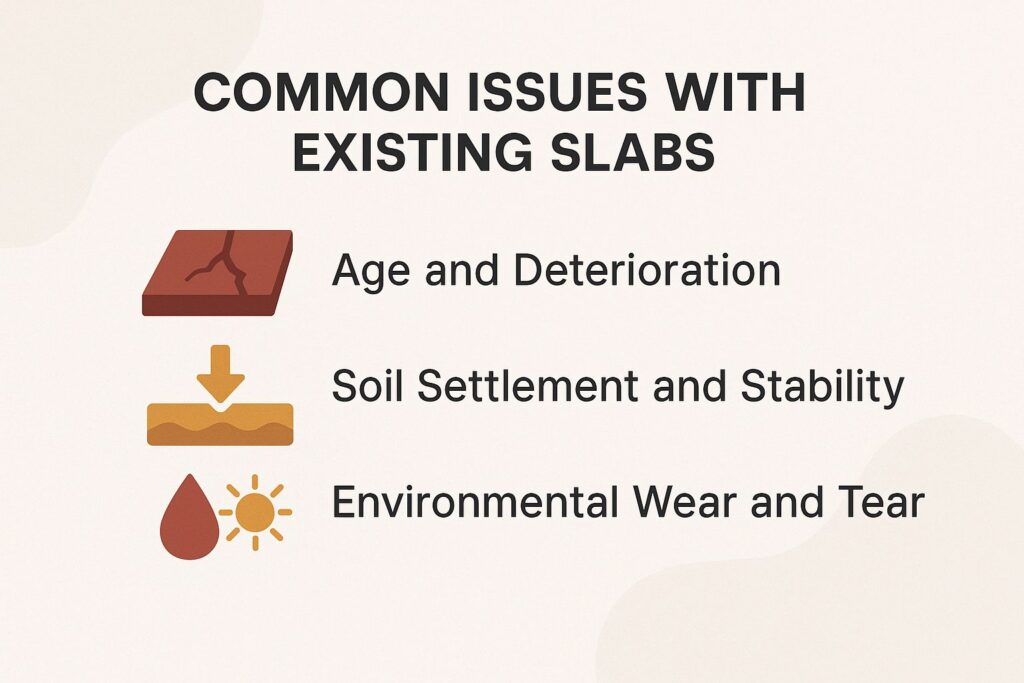
Existing slabs often face issues like 1/2-inch settlements or alkali-silica reactions, potentially compromising your steel building’s stability if not addressed early.
Age and Deterioration Factors
Slabs over 25 years deteriorate from carbonation reducing pH level below 9, leading to rebar corrosion; test with half-cell potential meter showing -350 mV as a corrosion risk threshold to plan corrosion protection.
To assess further, inspect for freeze-thaw cycles, which cause spalling in 20% of northern U.S. slabs according to FHWA data, and chemical attacks from sulfates that accelerate degradation.
Use the NACE SP0178 guidelines to evaluate corrosion. Include visual surveys and core sampling.
For mitigation, apply silane-based sealers at $0.50 per square foot to increase water resistance and limit chloride ingress.
In a real case, a 30-year-old Midwest slab required a $4,000 concrete overlay after testing revealed active corrosion, restoring durability for another 15-20 years.
Regular cathodic protection systems, like impressed current anodes, can prevent recurrence in high-risk areas.
Soil Settlement and Stability
Differential settlement up to 1 inch can crack slabs; perform a plate bearing test to verify soil CBR of 5% minimum, or add helical piers at $200-300 each for stabilization.
To diagnose and address this, follow these key steps:
- Use a total station to survey the site and check tolerances to within 1/4 inch. Spot any uneven settlement patterns.
- Obtain a geotechnical report assessing expansive soils, focusing on shrink-swell potential exceeding 3%.
- Mitigate issues with targeted grout injection or additional piers.
For instance, in Texas clay soils, a retrofit experienced 2-inch heave, resolved by installing 12 helical piers at a total cost under $4,000. Refer to ASTM D1196 for accurate settlement analysis to maintain slab strength over time, following ASCE guidelines.
Environmental Wear and Tear
Exposure to deicing salts accelerates wear, eroding 1/16 inch annually; install drainage slopes at 1/4 inch per foot, perimeter insulation, and vapor barriers to prevent moisture ingress below 15% RH.
Beyond salts, concrete faces UV degradation, causing minor fading over time, and acid rain with a pH level around 4.2, which etches surfaces and weakens integrity. To combat these, apply epoxy coatings like Sherwin-Williams’ ArmorSeal, at about $2 per square foot, forming a durable barrier against moisture and chemicals.
For instance, a study on coastal slabs via ASTM C1218 testing revealed chloride penetration up to 2 inches deep after five years of exposure, underscoring the need for protection.
Do yearly inspections with a chloride ion probe to find early chloride entry and make it last longer in tough conditions. Pair these with sealants reapplied every three years for optimal results.
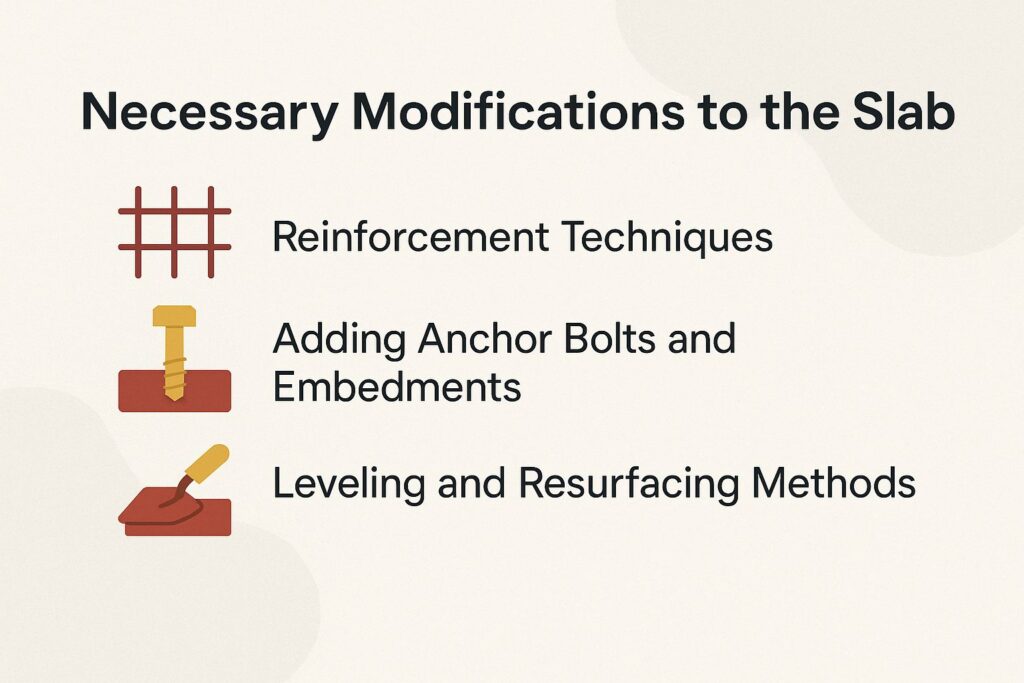
Necessary Modifications to the Slab
 \
\
Modify your slab by drilling for 3/4-inch anchor bolts with epoxy like Hilti RE-500 and resurfacing uneven areas to achieve 1/8-inch flatness. This preparation ensures secure steel attachment, a critical factor highlighted in the pros and cons of steel buildings in 2023.
Reinforcement Techniques
Strengthen weak areas by epoxy-bonding #5 rebar dowels at 12-inch spacing or using carbon fiber wraps like SikaWrap, increasing tensile strength by 50% per manufacturer tests.
For epoxy-bonding, drill 6-inch deep holes using a rotary hammer drill (e.g., Bosch GBH 2-28), clean debris with compressed air, and inject two-part epoxy like Hilti HIT-RE 500 (mix ratio 1:1). Insert #5 rebar (5/8-inch diameter), torque to 50 ft-lbs if needed, and allow 24-hour cure.
Alternatively, for carbon fiber wraps, grit-blast the surface for adhesion, apply Sikadur-300 epoxy adhesive, and lay SikaWrap-230C sheets in two layers, overlapping 4 inches. Saturate with epoxy roller; full cure takes 7 days at 73 degreesF.
Per ACI 440.2R-17 guidelines, this FRP method boosts flexural capacity by up to 100% in seismic retrofits, as seen in a California bridge project increasing load rating from 36 to 72 tons.
Adding Anchor Bolts and Embedments
Drill and set J-bolts or expansion anchors like Red Head Trubolt at column bases, torquing to 75 ft-lbs with a calibrated wrench to meet AISC design loads.
Follow with a step-by-step installation:
- Lay out the template using the steel frame print for 1/16-inch accuracy, marking anchor locations precisely.
- Install chemical anchors like Hilti HIT-RE 500, allowing a 30-minute cure time before loading.
- Perform pull-out tests to 1.5x the design load per AISC 360-16 standards.
For a 20×30 shed, this used 16 anchors at $800 total.
Leveling and Resurfacing Methods
Use self-leveling compound such as Ardex K 15 for pours from 1/4 inch to 1 inch thick, or grind down high spots with a 7-inch diamond cup wheel on an angle grinder to get 1/16-inch accuracy.
For minor imperfections under 1/2 inch, grinding is cost-effective at about $1 per square foot, using a dry method to avoid slurry mess-ideal for quick fixes in garages or warehouses. For deeper flaws over 1 inch, opt for a topping slab poured wet at $3 per square foot, incorporating a bonding agent like Ardex P 51 for adhesion.
Follow these steps per ICRI Guideline 310.2R:
- Shotblast the surface to CSP 3 profile (minimum 3 minutes per 100 sq ft);
- Mix and apply compound in 10×10-foot sections, allowing 24-hour cure.
Example: Leveling a 1,000 sq ft slab costs around $2,500, ensuring a smooth, durable finish.
Step-by-Step Construction Process
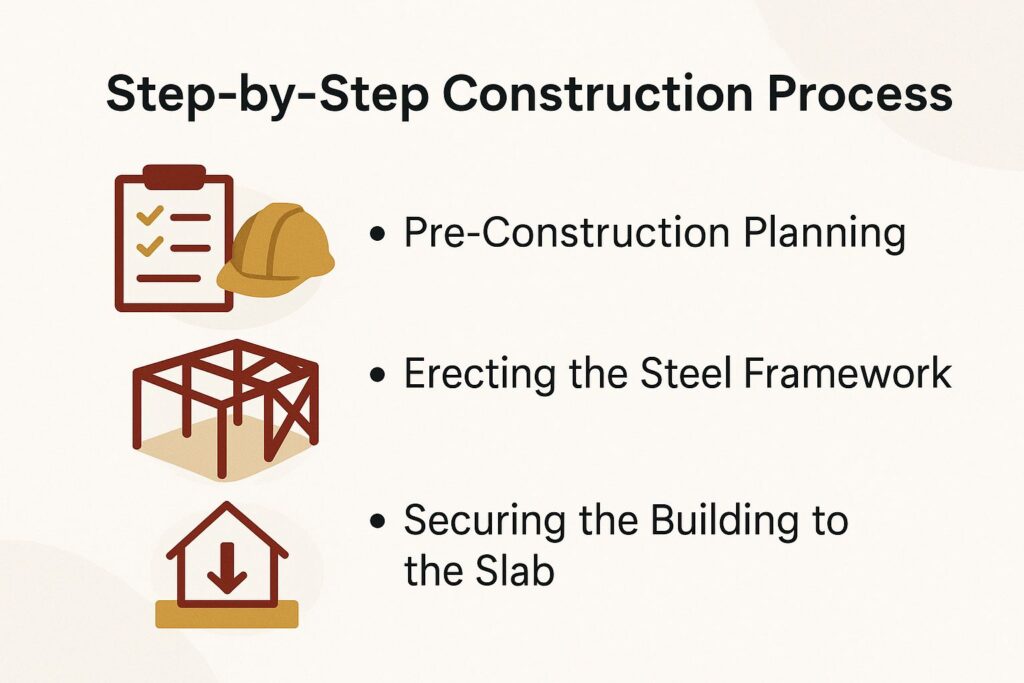
Build your steel structure in 7-10 days by planning permits first, erecting with a 20-ton crane, and bolting to the slab for a stable 1,500 sq ft workshop.
Pre-Construction Planning
Start planning by securing permits ($500-2,000), including provisions for HVAC systems, and conducting a soil compaction test to 95%, then grade the site to 2% slope for drainage around your existing slab.
Next, call 811 (free service) to locate underground utilities, preventing costly damages-required by federal law under the Common Ground Alliance. Use stakes and string lines to mark the footprint.
Make sure it lines up with local zoning codes and ADA compliance from the International Code Council (ICC).
For slab extensions, consult an engineer ($300-800) to verify load-bearing capacity, as per ASTM D698 standards. Rent a plate compactor ($50/day) to recheck compaction post-grading.
Common pitfall: Ignoring frost lines-dig footings 36-48 inches deep in northern climates. This prep phase typically takes 1-2 weeks, setting a solid base for framing.
Erecting the Steel Framework
error 400- bad request
Securing the Building to the Slab
Tighten the anchor bolts to 60 foot-pounds of torque in a star pattern. Use string lines to check alignment and confirm the frame is square, with diagonals within 1/2 inch.
Once tightened, insert nuts and washers on all embeds to prevent loosening, following ASTM F1554 standards for anchor rods.
To line up objects in a straight line, pick a laser level like the Spectra Precision LL300N. It has +-1/8 inch accuracy at 100 feet.
If base plates require reinforcement, weld them per AWS D1.1 code guidelines to achieve structural integrity.
Testing methods include snug-tight connections for non-critical joints versus pretensioned for high-load areas, verified with a torque wrench.
In a recent commercial building project, 24 bolts were secured this way, passing post-install inspection by a certified engineer in one day, ensuring code compliance and safety.
Pros and Cons of This Approach
Using an existing slab cuts costs by 25% and speeds setup, but requires $3,000-5,000 in potential mods to match your steel building’s demands.
Key Advantages
Save $10,000-20,000 on new foundation pouring while reducing build time from 4 weeks to 1, enabling quick DIY construction setup for your residential garage or workshop.
Opt for helical pile foundations as an alternative, which can support LEED certification. Key benefits include:
- 1) Cost savings of 30% compared to new slabs (RSMeans 2023: $6/sq ft vs. $9), ideal for 1,000 sq ft projects.
- 2) 50% faster installation, avoiding wet concrete curing.
- 3) Eco-friendly reuse of materials, cutting 10 tons of CO2 emissions per project (EPA estimates).
For example, an Oregon homeowner erected a 24×30 shed in 5 days using Chance Helical Piles, recouping costs in 2 years through storage rental. Drawback: Initial site assessment may add $1,000-2,000, but it’s offset by long-term durability.
About the Author
Written by Jason Caldwell, a Texas Tech University graduate with a bachelor’s degree in Construction Engineering. As the owner of a successful metal building supply and construction company in Oklahoma for 15 years and a writer and editor for Steel Building Zone, I specialize in helping businesses design and build durable, high-performing metal structures for commercial and industrial use.